This week's prompt is "Favorite Photo." Our first favorite photo is the wedding photo of my great grandparents, George Henrickson and Malvina Anderson.
Sunday, February 8, 2026
Favorite Photo
Friday, December 26, 2025
Memorable
The last prompt of 2025 is "memorable." This Fall I came into contact with the wife of a descendant of Jonas Fahnstrom, brother of Ingrid Fahna. She is the family historian in her family and had a wealth of information on the Fahnstrom/Fahna family in America, and their life in Sweden. It was her research into her husband's family in Sweden that greatly helped me in researching our branch of the family. I am eternally grateful to her for putting that online as it helped me so much in my research. Out of all the information she sent me, 2 pieces really stood out. One was a picture, and one was a letter.
The first is a picture of a young George Henrickson. I'm guessing he was in his early 20's when the picture was taken. He arrived at age 17 and was married at 25. You can see just how handsome he was. No wonder Malvina fell in love with him. I really like this picture because it's rare to get a picture of an ancestor so young in age. Most of the pictures I've seen of George are when he's older, and his health has started to fail. In this picture he's young and has his whole life ahead of him.
![]() |
| George Henrickson |
Allegan, April 22nd, 1938.
Dear Amanda.
You will probably be surprised to get a letter from me. I don’t know that I
have ever written to you but I want you to know that Goran is ill. He has been ill since the beginning of March but during these last few weeks he has been in bed and I fear the worse.
He has become so thin and it seems he gets weaker and weaker day by day so I have been thinking, maybe, if it’s possible for you, that you could come and see him.
He is himself having great courage and believes that he will recover and it is good because the doctor says that this is the best of medicine for him.
If you can come, write me a few lines in advance but say nothing more than I have written that he us I’ll and that you are coming to see him.
If you will be coming by railway it would be best to get off at Kalamazoo because there aren’t any passenger trains going to Allegan anymore.
I have two daughters living there.
They will meet you and give you the address to Eulalia. If you write to her they will meet you and bring you here.
Write me in English.
Her address is Mrs Charles Marsh
1023 Eagleston Avenue.
Kalamazoo
Michigan.
Her telephone number is 8071
Maybe you have got a car and will get someone to drive you here.
That would be the least trouble.
I would like you to know, though, that he is ill
My two youngest boys are at home and are doing the work now.
Hope that all of you are well. Now I want to finish this time by many dear greetings to all of you. Kindly and in a hurry.
Malvina.
Excuse my bad writing. I haven’t written in Swedish for a long time. I have almost forgotten how but I hope that you will be able to read.
Saturday, September 20, 2025
Animals!
This week's prompt is "Animals." Living and working on farms, our ancestors were with animals all the time. Here is a collection of my ancestors and relatives with animals over the years.
![]() |
| Bum |
![]() |
| Horace Ashley with cat |
![]() |
| Boys on outhouse |
![]() |
| Strandt siblings with horse |
![]() |
| Carl Strand with horses. Around age 14. |
![]() |
| Carl Strand horses, approx. 1917. |
Another picture of Carl Strand's horses.
![]() |
| Ray and Evald Henrickson with horses. |
I also have a picture of my grandpa Henrickson with his brother, Evald, and their team of plough horses.
![]() |
| Ray Henrickson with cows |
And last but not least, here is Ray Henrickson with some of his cows. This picture was taken in 2003. He had a great affection for cows.
![]() |
| Ray Henrickson with horse. Rowdy? |
I found this picture after I first published the blog, but I wanted to include it. It just shows how important horses were to farmers before tractors.
Saturday, August 30, 2025
Off to Work: Mildred Strand
This week's prompt is "Off to work." Besides farming, the other profession that keeps repeating itself in our family is teaching. We have had a great many teachers over the years. Granted, women did not have many opportunities for other careers back in the day, but it is interesting how many women in our family have taught over the years. Carl Strand's mother, Mary Pulsipher, taught school before marrying William Strandt. Mary even taught school again in her later years. She attended Western Michigan College in the 1940's to add to her teaching credentials. Her daughter and Carl's older sister, Eva, also taught school. Eva's daughter, Ruth, grew up to be a schoolteacher in Florida.
![]() |
| June 1941 |
Saturday, August 23, 2025
Play Time: The Henrickson sisters
This week's prompt is "play time." There are so many ways to go with this prompt but while researching Henrickson ancestors I discovered some play time the Henrickson sisters had back in August 1928.
On August 11, 1928 Grace Henrickson married Harold Wall. Harold was an apprentice plumber and Grace worked as a clerk. Witnesses were Mr. Ralph Quarry and Miss Ingrid Henrickson. Ralph Quarry had married Grace's sister, Pearl, in January 1927. The wedding took place at the Swedish Lutheran Church with the reception at the Henrickson farm.
Saturday, August 2, 2025
Earliest Ancestor: Anders Svensson Lindblad
This week's prompt is "Earliest Ancestor." Our earliest Swedish ancestor is Anders "Andrew" Svensson Lindblad.
Anders was born April 29, 1836 in Slatthog, Kronoberg, Sweden. He was the third child and second son of Sven Andersson Fahna and Kajsa Catharina Jonasdotter. He was older brother to Ingrid Svensdotter Fahna, and uncle to George Henrickson.
Anders married Britta Amandsdotter on May 14, 1859. Anders and his new wife moved in with his parents and lived with them for the first few years. Anders joined the Swedish Army, like his father had, and soon had his own soldier's cottage to move into. Upon joining the Army he took a soldiers last name, He chose "Lindblad." "Lind" means "lime tree" and "blad" means "leaf." So, "Lindblad" has a connection to nature and trees.
Anders and Britta had 4 sons between 1860 and 1867. Their youngest son, Aron, was born in 1867 and passed away in 1868. Cause of death was a stroke of some kind. Sweden was undergoing a famine between the years 1867-1869. 1867 had been unusually cold, and 1868 was a drought year. People and animals were starving all over Sweden. Undoubtedly the famine played a part in Anders and Britta's decision to leave for America.
On May 14, 1869 Anders, Britta, and their 3 remaining sons left for New York. Apparently, they had originally intended to go to Denver, Colorado, but ended up in LaPorte, Indiana. After arriving in LaPorte, Anders, who now went by "Andrew" took up farming. Andrew and Britta had a daughter who was born and died on the same day, February 10, 1873. The next year, July 31, 1874, Stina Marie would be born. Their second daughter, and youngest child. Andrew and Britta would suffer one more death of a child. Carl, their youngest son, would die in 1876. Reportedly Carl drowned in a lake. He was only 12 years old.
Andew and Britta joined the Bethany Lutheran Church, and sometime before 1880 Britta's mother, Mary, came from Sweden to live with the family.
The 1900 Federal U.S. Census tells us how the family was doing after being in the States for 30 years. Andrew and son, George, had both obtained papers to become citizens but hadn't been naturalized yet. Interestingly, Britta had no papers. Why? As a married woman, she would obtain citizenship when her husband did. When he became naturalized, she would automatically become naturalized too. Andrew owned his farm, but it did have a mortgage. He could read, write, and speak English. Britta could read and speak English but was unable to write in English. Son George lived with his parents and helped his father work the farm. Daughter Stina lived at home and worked as a Servant. She would later move out when she married.
While Andrew and Britta came to America in 1869, it would be until 1880 when the next family member of Andrew's came to America. That would be his nephew, Sven Fahnstrom, his brother Jonas's son. Starting in the 1880's the sons of Jonas Fahnstrom started coming to America. Our grandfather, George Henrickson, would come in 1892. Jonas and his wife and three youngest children came in 1893 and sister, Ingrid came in 1912. Some might call it chain migration, but our Henrickson family started in America with Anders "Andrew" and Britta Svensson Lindblad. Their pioneering spirit helped bring other relatives to America, including George Henrickson. His ticket to America was paid for by someone in America. The most likely candidate being his Uncle Anders.
Andrew died June 27,1907, at home in LaPorte. He was 71. Britta passed away on April 12, 1923. She was 85 years old. The 1920 census says that Britta could now read and write English. It also lists her as a naturalized citizen. She also owns the farm, with no mortgage. Her son George lives with her and works the farm.
Saturday, July 12, 2025
Travel
This week's prompt is "Travel." I thought I would write about what it was like to travel to America during the 1800's.
Prior to around 1860, our ancestors would have sailed to America on a ship with sails. It would have taken around 4-6 weeks to arrive. They would have been in steerage, which meant they were crammed in with everyone else and had little to no privacy. Cholera and Typhoid were common, not to mention sea sickness. Food and hygiene were bad. It was not a pleasant experience at all. This changed somewhat with the introduction of steam powered ships. Steamships could make the journey across the Atlantic in 2-3 weeks. The living conditions were also a bit better. The first ancestors to come to America on a steamship were Carl and Ulrika Anderson.
Carl and Ulrika left Goteborg, Sweden on a Friday afternoon and arrived in Hull, England on a Sunday afternoon. This was traditionally how sailings went. Leave on a Friday and arrive on Sunday. The journey took around 40-50 hours. They would have needed to be in Goteborg a week before sailing to meet with the ticket agent from the company and go through all the paperwork. They would have needed paperwork from their parish saying where they were leaving from, and where they were heading to. Hull was the major port for arrivals of emigrants traveling to America from northern Europe. After arriving in Hull Carl and Ulrika would have stayed onboard their ship until the train was ready to take them to Liverpool. The train usually left on Monday morning around 11 am and arrived in Liverpool around 3 pm. There were no bathroom facilities onboard the train. At least not for 3rd class passengers. In Liverpool they would stay until they could board the ship taking them to America. I'm not sure how long they would have stayed in Liverpool.
Traveling 3rd class, or "Steerage", was not easy. Passengers would be provided with a place to sleep and food. Passengers had to provide their own mattress and bedding. Also, their own plate, mug, knife, fork, spoon, and water can. They were also advised to make sure they had a good selection of clothes as clothes were more expensive in America. All of these items could be found in Liverpool for sale. Gunpowder was prohibited. Weapons needed to be left with the captain and crew for safe keeping. Valuables were also supposed to be left with the captain or ship's purser.
Food was served by the crew. It probably sounds better than it actually was. Passengers would be served tea and coffee, bread and gruel, soup, beef, pork, fish and potatoes. They were allowed 10-20 cubic feet for luggage.
Passengers were also separated by families, single men, single women. The single men and women would be separated with families in-between them.
After arriving in New York, 1st and 2nd class passengers were allowed to leave the ship. They were seen as more trustworthy. Steerage passengers had to remain on ship until it was time for inspection. They would be given a 6 second once over by a doctor, asked a few questions, and as long as they weren't sick or proclaimed themself an anarchist, they were allowed entry. Anyone could buy a ticket and sail to America to start over.
Carl and Wilhemina Strandt sailed to America in late 1871. They sailed from Hamburg. By the time they arrived in Hull, Hull had built a large waiting room at the train station for the emigrants waiting for the Liverpool train. The waiting room had bathroom facilities, a place to wash up, and a chance to meet with the ticket agents. It was also shelter from the weather. Their passage to America would have been similar to Carl and Ulrika's passage. Crowded conditions in steerage, basic food, and they would have needed to pack their own bedding and cutlery.
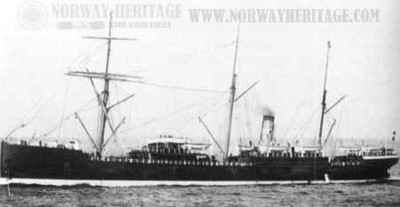
When Sven G. H. Johansson "George Henrickson" came to America in 1892, things had improved somewhat. He traveled on the Thingvalla line. His ticket had been bought in America by one of his uncles. The ships in this line were owned and operated by Scandinavians. The crew were all Scandinavian. They promised a quick, low-cost journey to America. The below is taken from the site A Thingvalla Line promotional pamphlet 1887
Is divided into different departments for families, for unmarried males and for unmarried females. Order and cleanliness is provided by crew specially employed for the task. The food is fresh and rich, made of first class food supplies. It is handed out in such rich portions, so it should not be necessary for the passengers to bring any additional food supplies for the voyage to New York The food is served to the passengers by stewards, thus on other steamship lines the passengers usually have to pick up their food at the galley, which of course will be unpleasant in bad weather.
The meals consist of:
Breakfast: Coffee with sugar, bread or biscuits with butter
Dinner: Beef and soup with potatoes and bread. Fish, clipfish with souse and fruit soup, Lobescauce? and Rice soup, varying through the week days.
Evening: Tea with sugar, bread and butter
Everyone gets as much to eat as desired. To the male passengers who desires, it is served every morning one dram of liquor. There are also rich supplies of water. There are bakeries on the ships, where fresh bread is baked every day. The between deck (steerage) is high, light and spacey, and is heated in the cold part of the year. Mothers of infants will receive milk or vrilfood free of charge.
George would have arrived at Ellis Island, where once again as a passenger in steerage, he would have had to wait to pass customs and inspection before being admitted into the country. It normally took around 5 hours.
A couple of final things about Thingvalla lines, they gave out tokens for luggage. When you arrived at your final destination, you exchanged your token for your luggage. Much like a luggage tag on checked suitcases today. Also, they were the only line that promised a direct route to America from Scandinavia. George sailed from Malmo, Sweden to Lubeck, Germany. Then, took the train to Copenhagen and sailed direct to America from Denmark, completely bypassing England.
Ingrid Fahna, George's mother, came to America in 1912. She was able to sail on the Lusitania. She sailed 3rd class, but by that time things had improved immeasurably for 3rd class passengers. She didn't have to supply anything and had much better sleeping and eating conditions. Her ship also sailed the fastest. She crossed the Atlantic in 10 days, whereas others took an average of 2 weeks.
Researching these companies, they reminded me of airlines today. Steerage is now Economy. 2nd Class is Business, and First Class is still First Class. Thingvalla would be the low-cost Spirit or Frontier airlines of today. They all promised to get you to America. The only difference is how much you were willing to pay.
Another thing, many of these companies crammed as many passengers as they could onto their ships. There were complaints about the food, conditions and safety of many of these ships bringing emigrants to America. While researching I found an undercover report that the American government did on a ship. They sent a woman investigator undercover in the late 1800's to see what the conditions were like. She found poor food, poor sanitary conditions, instances of sexual harassment and emigrants being treated more like cattle than human beings. The governments of the United States, England, and others would put regulations and restrictions on the companies. As the undercover report showed though, they weren't always followed.
These are the websites I used to write this blog.
Journey In Steerage from Northern Europe - 1871 | GG Archives
A Thingvalla Line promotional pamphlet 1887
Migration from Northern Europe to America via the Port of Hull, 1848-1914
Questions, comments, additional information? Let me know down below or email me. Please feel free to share and post with others who may be interested.
Image of Hekla steamship that George Henrickson sailed on to America from Copenhagen, Denmark.
Saturday, June 14, 2025
Artistic: Henrickson and Strands
This week's prompt is "Artistic." That immediately made me think of something Mildred Strand wrote in a letter to my mother back in February 1981. She mentioned how proud she was of the drawing talent of her grandchildren, especially Ilene, Marvin, Esther and Venon.
Saturday, April 12, 2025
March Notables
March has been a month filled with lots of activities. Lets get down to birthdays, anniversaries, and deaths in the month of March.
Birthdays:
March 2:
1840, Joseph Bellegraph, my 3x great grandfather on my paternal side, born in Pomerania, Poland.
1873, Elnora Truman, my maternal 2x great grandmother. Born in Michigan.
March 10:
1883. Selma Anderson, my maternal great grandaunt. Born in Michigan.
1901. Carl Strand, my maternal great grandfather. Born in Michigan.
1921. Victor Henrickson, my maternal granduncle. Born in Michigan.
Ilene Henrickson, my mother. Born in Michigan.
March 14:
Paul Henrickson, my maternal uncle. Born in Michigan.
March 19:
1913. Catherine Ashley, my paternal grandaunt. Born in Michigan.
March 22:
1916. Carl Thompson, my paternal granduncle. Born in Michigan.
March 23:
1856. Eva Brownell, my maternal 3x great grandmother. Born in Michigan.
March 24:
1912. L. F. Thompson, my paternal grandfather. Born in Michigan.
March 27:
1834. Carl F. T. Strandt, my maternal 3x great grandfather. Born in Mecklinberg, Prussia, Germany.
1873. Charles Bellinger, my maternal 2x great grandfather. Born in Michigan.
March 28:
1862. Joannes "John" Knach Conors, my paternal 3x great grandfather. Born in Pomerania. Poland.
March 31:
1916. Esther M. Henrickson, my maternal grandaunt. Born in Michigan.
Anniversaries:
March 26, 1874. Albert Pulsipher and Eva Brownell.
Deaths:
March 9:
1965, Sidney Henrickson. Maternal granduncle.
March 12:
1989, Eulalia Henrickson. Maternal grandaunt.
March 21:
1951, Evald Henrickson. Maternal granduncle.
March 10 definitely stands out with 4 birthdays on it. Out of the 31 days of March, there are birthdays, anniversaries and deaths on 14 of them.
Did I miss anyone? Let me know.
![]() |
| Carl Strand, upper left. Born on March 10, 1901. |
Saturday, February 22, 2025
Migration
The prompt for this week is "Migration." Our ancestors all migrated here from somewhere else. I thought I'd take a look at some of them this week.
Prior to 1875, when the Supreme Court ruled that it was the responsibility of the Federal Government to make and enforce immigration laws, there was no overriding immigration policy. Some states had their own laws regarding immigrants but the United States as a whole had no policy. Anyone, from anywhere, arriving on a boat could immigrate to America.
On August 22, 1833, William Mabbs,Jr and his parents, William and Hannah Mabbs arrived in New York City on the ship "Amity." They had departed London, England and sailed in steerage to America. William and Hannah came with their 7 children ranging in age from 12 to 1 year old. We don't know why they decided to sail to America. William had a business selling soap in London and was a Methodist. He may have felt he could be more prosperous in America, or perhaps he felt he could practice his faith more openly. Either way, he decided to make the journey across the sea, leaving his parents and siblings in England.
On November 29, 1892, Sven Goren Henrich Johansson left from Malmo, Sweden and sailed to Copenhagen, Denmark on the ship "Kopenhamn". From Copenhagen he sailed directly to America on the ship "Hekla" arriving on December 19, 1892. He was 17 years old. From the manifest we know that his ticket was paid for by someone else. We know he already had several family members living in the United States. He had aunts and uncles and cousins. It is most likely that one of his uncles paid for his ticket to America. What is slightly unusual for Sven, who later changed his name to George Henrickson, is that he left from Malmo and sailed to Copenhagen, instead of leaving from Goteborg and sailing to Hull, train to Liverpool, and then ship to America. I learned that it was cheaper to go from Malmo to Copenhagen and then sail to America. George also lived in southern Sweden so Malmo may have been easier to travel to then Goteborg on the west coast.
Ellis Island opened on January 1, 1892, so George would have passed through here. He would have seen the Statue of Liberty as he sailed into New York harbor and then waited for a ferry boat to take him to Ellis Island to be processed. He would have been asked identifying questions, given a physical, and then released to be on his way. We know he probably went to extended family first in Indiana and Illinois. He eventually made his way to Allegan, Michigan where he married Malvina Anderson, daughter of Carl and Ulrika Anderson.
Saturday, February 1, 2025
Challenge
This week the prompt is "challenge" so I am keeping up with my own challenge of recording the births, deaths, and marriages of each month. February is the shortest month and as a result I didn't find that many results for February.
Births in February include:
Marvin Henrickson, born on Feb. 11, 1944.
2x great grandfather William Strandt, born on Feb. 15, 1876. (Chicago, Illinois)
Gary Thompson, born on Feb. 20, 1949.
3x Great grandmother Wilhelmina Gley Strandt was born on Feb. 21, 1841, Prussia (Germany)
Paternal 2x great grandmother Mary Bellegraph born on Feb. 26, 1869 in Pomerania (Poland)
Marriages
Despite being the month of Valentine's Day, February only contains two marriages.
Great grandparents George Henrickson and Malvina Anderson were wed on February 21, 1900.
Paternal 2x great grandparents Mary Bellegraph and Joannes "John" Knach Conors were wed on February 7, 1888 in Indiana.
Deaths
Great granduncle Frank Anderson (older brother of Malvina Henrickson) died on February 5, 1939.
Paternal 3x Great grandmother Abigail Eldred died on Feb. 9, 1847.
Marvin Henrickson and 2x Great grandmother Elnora Truman Bellinger both died on Feb. 28. 2005, and 1953 respectively.
That's for this month. Not a lot happening in February. March will be completely different. Just the number of birthdays to keep up with. April, too! :)
Feel free to add additional birthdays, deaths, and marriages in the comments below. I try not to go back too many generations, or, go too much into extended family.
![]() |
| Mary Bellegraph and John Knach Conors Wedding day 1888. |
![]() |
| George Henrickson and Malvina Anderson Wedding Day 1900. |
Unless noted, births, deaths, and marriages occurred in Michigan. If they occurred in another state, or in "the Old Country" I tried to note it, if available.
Thursday, January 2, 2025
In the Beginning
Happy New Year!
The first prompt of 2025 is "In the beginning." I decided to do something I've wanted to do for a while, compile a list of all the birthdays, deaths, and anniversaries on a monthly basis. January is the first month so it's a good place to start.
Let's start off on a happy note with some of the birthdays I've found in January.
My paternal Great aunt Fern Thompson was born on January 1, 1927.
January 3rd has 2 birthdays, Sidney Henrickson in 1902 and my Dad in 1941.
Frank Ashley, a paternal Great Uncle was born on January 4, 1915.
Paternal 3x Great Grandmother Abigail Eldred was born on January 9, 1804.
Paternal Great Grandmother Emilia Dobbratz Ashley was born on January 15, 1888.
Great Grandfather George Henrickson was born January 19, 1875.
2x Great Grandmother Mary Pulispher Strandt was born January 20, 1877.
January 23 was the birthday of paternal 2x Great Grandfather Andrew Thompson in 1859 and paternal Grand uncle Orville Ashley in 1919
Toni Thompson was born January 28,1945.
Next up we celebrate the marriages that occurred in January.
Paternal 2x Great Grandparents Orville Ashley and Kate Eldred were united in marriage on January 1, 1863.
2x Great Grandparents Ingrid Fahna and Johan Jonasson were also united in marriage in January, on the 10th, in 1874.
Our In Memoriam segment is sadly, the largest.
January 1 was the day Grand Aunt Esther M. Henrickson and Grand Uncle Lynn Bellinger passed away. In 1995 and 1981.
3x Great Grandfather Madison Truman passed away on January 2, 1884.
3x Great Grandfather Sven Fahna passed away on January 3, 1881 and Victor Henrickson passed away on the same date in 1923.
Howard C. Strand passed away on January 8, 2017.
Paternal 3x Great Grandfather Riley Thompson passed away on January 9, 1908.
Grand Aunt Helen Bellinger passed away on January 10, 1980.
3x Great Grandfather Carl F. T. Strand passed away on January 18, 1914.
Paternal 2x Great Grandmother Mary Bellegraph Conors passed away on January 21, 1941.
Grandfather Lawrence F. Thompson, Sr, passed away on January 19, 2006.
3x Great Grandmother Loretta Foster Bellinger passed away on January 30, 1912.
This list is by no means inclusive. If you know of any other birthdays, anniversaries or deaths in January, please list them below in the comments or email me.
![]() |
| Colonel Howard C. Strand. Passed away on January 8, 2017. |
Amanda Holm
Amanda Holm was born March 21, 1868 in Slatthog, Sweden. Her father was the local blacksmith. She was the youngest of 6 children. When she...
-
To hear many people tell it, no one ever got a divorce before 1976. That divorces have only been common in modern society. This could not be...
-
This week's prompt is "Off to work." Besides farming, the other profession that keeps repeating itself in our family is teachi...
-
This week's prompt is "Earliest Ancestor." Our earliest Swedish ancestor is Anders "Andrew" Svensson Lindblad. An...
.jpg)


.jpg)


.jpg)
.jpeg)
.jpeg)


.jpg)


.jpg)
.jpg)
.jpg)