Saturday, September 18, 2021

On the Farm

This week's theme is "On the Farm" so I decided to write about the Henrickson farm.  


Carl Johan Anderson lived in Sweden and worked for a railroad company. He was able to save $400 for his wife, Ulrika and himself to come to America.in 1870. The couple first settled in LaPorte, Indiana. While in LaPorte Carl heard about a railroad that was going to be built in the Watson Township area. Since he had worked on railroads in Sweden he decided to move to Michigan to work on this one. The name of the railroad was to be the Lake Shore Railway Company. Carl first bought 80 acres of land on section 31 of Watson Township. He later sold that land and bought 80 acres of land on section 32 of Watson Township. The land was cleared and cultivated. He later sold 40 acres to his brother-in-law Nils Johansson. Later, he bought an additional 80 acres to make a 120 acre farm. He was engaged in general agriculture. 

Carl and Ulrika raised their 3 children there. Carl liked the area so much he wrote letters to friends in Indiana and Sweden encouraging them to come to Michigan to live. Many took him up on it and a large Swedish community developed. 

On February 21, 1900 Carl and Ulrika's daughter Malvina married Sven Goren Henrik Johansson. Sven was a Swedish immigrant who was now going by the Americanized name of George S. Henrickson. He met Malvina when she was an organist at the Swedish Lutheran Church and he visited as a student minister. After marrying they moved north so George could work in the copper mines. Some time after 1913 George and Malvina moved back to the farm so Malvina could help take care of her aging parents. Carl died in 1915 and Ulrika died in 1918, at the home of her son Frank. After Carl and Ulrika's deaths the farm was equally divided between their 3 children, with each child getting 40 acres. George and Malvina were given the 40 acres with the house on it. At some time George and Malvina purchased 40 acres from her brother Frank, giving them an 80 acre farm. George and Malvina lived on the farm the rest of their lives, raising their 11 surviving children there. 

George and Malvina's son, Ray, stayed on the farm to help his father. He married Viola Strand and they raised their 8 children there. Ray grew crops and raised cattle. He stayed on the farm until his death in 2006. The farm is now farmed by Ray and Viola's descendants. Still in the Henrickson family.

In 1978 a plaque was presented to Ray and Viola to certify that the farm had remained in the same family for over 100 years. I think Carl and Ulrika would be proud to know that their investment was still in their family after all these years.


All of the information here came from a genealogy book on the Henrickson's prepared in 1998 for a Henrickson family reunion, a newspaper article profiling Raymond Henrickson from 2003. Also, census records and Swedish immigration records found online. 


Saturday, August 21, 2021

Tragedy: Malvina Olivia Anderson

Life is full of triumphs and tragedies. One of the greatest tragedies is the death of a child. I've found many instances of young children who didn't live to adulthood in my family tree. Most deaths were caused by diseases which are easily preventable today with vaccines and healthcare. A few were caused by accidents. This is one of those cases. I had heard about it growing up, but until I found a newspaper article with my great, great grandfather's first hand account, I didn't realize just how tragic it was.


Carl Johan Andersson and Ulrika Sophia Johannesdotter were married just outside Stockholm, Sweden on December 3rd, 1866. Carl worked for the railroad industry in Sweden. On May 30, 1867 a baby girl was born to Carl and Ulrika. The baby didn't survive. In the record books the child wasn't even listed with a name so I'm guessing the child was probably premature. She died the same day she was born.


In 1870 Carl and Ulrika immigrated to America, eventually settling in Allegan, Michigan. In 1873 a son, Frank Oscar Anderson was born to them. On April 17, 1878 a daughter, Malvina Olivia Anderson was born. In August of 1878 the local Swedish settlers decided to organize their own Lutheran church. Carl, who now went by Charles, and Ulrika were founding members. In March 1879 Charles offered to donate some of his farmland to the Church to be used as a cemetery. The offer was gratefully accepted and was formalized in April 1879.


The house and farm that Charles and Ulrika lived on was near railroad tracks. The trains would often go by. My mother, who grew up in the same house, would tell me stories about the trains going by and the engineers sometimes throwing candy to the kids who waved at them. The tracks could even by seen from the yard of the house.


On the early evening of July 2, 1879 Charles was having supper inside, and Ulrika was outside, picking berries. Both thought the other one was watching Malvina. Malvina had wandered away from the house and down to the railroad tracks. Unfortunately a train was passing by at the time. Malvina was hit and immediately killed. I found a newspaper article of the accident and I'll let that provide more details. 


Malvina Olivia Anderson thus became the first person buried in the church cemetery. On the land donated by her parents. I had often heard this story, but I never knew the particulars until finding the newspaper article. I can't begin to imagine the grief and sorrow Charles and Ulrika felt. Especially Ulrika after running towards Malvina. Also, at the time Ulrika was 5 months pregnant with her next child. That child, a girl, was born October 10, 1879. To honor Malvina's memory, this daughter was named Malvina Christina Anderson. Malvina Christina is my great grandmother. One more child, another daughter, was born to Charles and Ulrika on March 10, 1883. She was named Selma Cecelia Anderson.


I found an article with an explanation from the railroad about Malvina's death. 


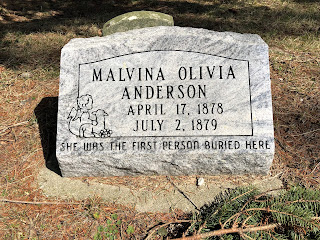
And a picture of Malvina Olivia's tombstone.


A picture of Charles and Ulrika and their 3 surviving children. After learning about Malvina Olivia's death I understand why Ulrika always looked sad in pictures.


Newspaper articles used come courtesy of the Allegan Journal, July 5, 1879. 


Saturday, August 14, 2021

Harriet Elizabeth Mabbs

 This week I'm writing about Harriet Elizabeth Mabbs. Harriet is Mildred Bellinger Strand's maternal grandmother. Harriet is my great, great, great (3x) grandmother.

Harriet was born June 27, 1850 in Hudson, Lenawee, Michigan. Her parents were William Mabbs and Martha Patty Warner. William was born in London, England but came to America as a child with his family.  I haven't been able to find Harriet yet on the 1860 or 1870 census. In fact, I don't have much information on her childhood at all. After her birth, the next record I have of her is her marriage to Madison "Elwin" Taylor Truman on April 22, 1869 when she is 18 years old. However I can only find Taylor Truman on the 1870 census working as a farmhand for a married couple. On March 18, 1870 Harriet gives birth to her first child, a boy named William Henry Truman. He is named after both his grandfathers. He's born in Jefferson, Michigan.  About 1872 Harriet has her next child, a daughter named Isabel Truman.  On March 2, 1873 Elnora Truman is born. Elnora is Mildred Bellinger Strand's mother. The next child, another daughter, is born in 1877. HIllsdale, Michigan. Mary E. Truman.

Sometime between 1877 and 1880 Madison and Harriet move their family to Arkansas. Their last child, Judson Elwin Truman is born May 28, 1880 in Little Rock, Arkansas.  The family didn't stay long in Arkansas, though, as at some point they moved back to Michigan. Madison died at the age of 34 on January 2, 1884 in Ransom Township, Hillsdale Michigan. I found a report of his death in a newspaper, but I haven't found the exact cause yet. Sadly for Harriet her father William died later that year in October. 

Harriet entered the next phase of her life on November 25, 1886 when she married Albert Bush in Montcalm, Michigan. Harriet was 36 and Albert was 42, It was the second marriage for both. I haven't been able to find out if Albert's first wife died or he was divorced. 

About 6 months later on May 2, 1887 Harriet and Albert's first child is born, a boy named William Joseph Bush. In 1889 a daughter named Dorothy is born. In 1891 Harriet has a baby born but it dies as an infant. In 1893 Nellie Eltah is born and in December 1895, at the age of 45, Harriet gives birth to her last child, a daughter named Georgiana Bush.

The 1900 and 1910 censuses find Harriet and Albert living in Montcalm, Michigan. On both census records Harriet lists 10 children as the number of children she gave birth to. On the 1910 census she lists "Laundress" as her occupation. She must've taken in washing from other families for extra income. 

In April of 1912 Albert passes away. He was 68. Cause of death was "Epithelioma under the left arm." I'm guessing it was some form of skin cancer. Harriet was 61.

The 1920 census finds Harriet living in McBride village of Day Township, in the county of Montcalm, Michigan. Harriet lists "Laundress" as her occupation. She reports that she owns her own home and owns it free and clear, with no mortgage. She knows how to read and write and she lives with her daughter, Nellie Bush. Nellie lists no occupation.

Harriet died on June 21, 1929. Death certificate lists cancer of the breast and something else as the cause of death. Senility is also listed as a contributing factor. According to the death certificate Harriet was only seen by a doctor for 10 days before her death. She passed away 6 days before her 79th birthday. 

I wish I knew more about Harriet, especially her early life. She married at 18 and had 5 children with her first husband. Moved her family to Arkansas in a horse and wagon, and then back to Michigan again. Lost a husband. Married again, and had another 5 children with him. I don't have any pictures of her, but I do have pictures of her oldest son, William, and her daughter Elnora. 


 The first picture above is William and his wife Eltah. The second picture is William on his farm in Trowbridge. The third picture is of Elnora with her husband Charles. Parents of Mildred Bellinger. Elnora is in the center. 

Harriet lived until 1929 so it's quite possible there may be a picture of her out there as an older woman. If anyone knows anything or has any pictures, please let me know. Thanks!

Please add any questions, comments or recollections in the comments below. 


Saturday, July 17, 2021

Transportation

 This week's prompt was "Transportation." I decided to write on the different means of transportation my ancestors used to get to Michigan. 

The first means of transportation used to get to Michigan is good old walking by foot. When Great Grandma Mildred Strand sat down and asked her grandfather, David Bellinger how he came to Michigan, he replied his father Oliver Bellinger was given a piece of land near Grand Rapids by the government. Oliver walked from near Cleveland, Ohio to Grand Rapids to claim it. The land proved to be too swampy to farm so he traded it to a man for an overcoat and moved further south. He found land near the Kalamazoo River and that's where he settled. 

Walking is certainly one means, but it takes a long time. Another means of transportation to get to Michigan was horse and wagon. In a biographical sketch done on my great, great grandfather Orville Ashley,(grandfather to Lois Ashley Thompson) it states that he came to Michigan with his parents when he was 10 years old from New York. His parents, Joseph and Mary Ashley had a 2 horse wagon team. They came from New York via Ohio where they rested for 6 weeks, and bought a cow. Then, they and the cow continued on to Michigan where they settled in Allegan County. 

Of course, before you can walk or ride to Michigan you have to get to America. The only way to get to America before jet airplanes was boat. Karl and Wilhelmina Strandt, (grandparents to Carl Strandt,) and their 3 children boarded the Hansa ship in Hamburg and sailed to Hull, England. They were in Steerage. Something I found out recently, but makes sense, is that immigrants on board ship had to bring their own supply of food with them on their journey to America. They didn't have All You Can Eat Buffets on the ship. Immigrants would bring their own food and be allowed to fix it and eat it every day. So, they not only had to pack their clothes and belongings, but they also had to pack food and supplies to get them to America. 

When Carl and Ulrika Andersson, parents of Malvina Anderson Henrickson, left Sweden to sail to America, they sailed on a ship named Orlando to get to Hull, England. From Hull, immigrants would take a train, included in the price of the passenger ticket to Liverpool. At Liverpool they would board their final ship to America. 

Of course in later years I'm sure some ancestors came to Michigan via railway and automobile. I just haven't found any written records of that. When I read about ancestors walking to Michigan, or how long and arduous the journey by ship was across the Atlantic, I'm amazed we're here at all! Travel, no matter how frustrating today, is definitely easier than it was in the 19th century. 

Sunday, July 4, 2021

Conflict: Strand v. Strandt

 This week's prompt was "Conflict." I can think of no bigger conflict in my family tree than the court case of Carl Strand suing his parents William and Mary Strandt over ownership of the Strandt farm. Sources for this post come from a summary of the final case before the Michigan Supreme Court, personal remembrances from family members, newspaper articles, and city directories. This is by no means a complete story of the case. Hopefully that will come later with more information.

William Strandt and Mary Pulsipher were married June 8, 1898. The 1900 census finds them living in Watson Township with William's parents, Karl and Wilhelmina Strandt. Oldest child Eva is one year old. Carl and Ruth are born in Michigan. Youngest son Howard is born in 1909 in Illinois. Soon after though the family moves back to Michigan. The 1910 census finds the family living in Trowbridge Township. William's father Karl lives with them but William is listed as the Head of household. In 1920 the family is listed as living in Watson Township again. There are no addresses listed on any of these census records so I'm not exactly sure WHEN William and Mary came into possession of their farm. I DO know that the farm was given to William and Mary by Mary's uncle Charles Brownell. Charles was involved in the lumber trade and made a lot of money. He moved to Louisiana and was QUITE successful there. He'll get his own blog post one day. Here's a picture of the farm from the early 1900's. 


Here's a picture of William and Mary standing by the well.


Fast forward to 1926. William and Mary are living in Kalamazoo, Michigan with Carl and his wife Mildred. According to the Kalamazoo City Directory, William and Mary and son Howard are living at the same address as Carl and Mildred and their three children, Howard, Viola and Marylaine. Ruth has married, but she did graduate from Kalamazoo Central High School, so I'm guessing she may have lived with Carl and Mildred too? This surprised me as I didn't know the two families had previously lived together.

William and Mary go back to the farm. The Depression hits and everyone is facing financial hardships. William falls into debt and is in danger of losing his farm to the bank for failure to pay taxes and bills. A deal is struck with Carl and Mildred. Carl and Mildred will move in and take over the farm. William and Mary will move out. If William and Mary become unable to care for themselves they can move back to the farm.  An agreement was entered into on November 3, 1933. Carl took possession of the farm on February 1, 1934. Carl secured a loan of $2000 from a bank. He spent $1800 paying off the mortgage, liens, and back taxes. He spend the other $200 to make improvements to the farm. Putting up fences, fixed the roof, bought 2 cows and a manure spreader and made the farm workable again.  All parties agreed that Carl's hard work saved the farm from going under. However, William and Mary, who had agreed to move out, didn't, and therein lies the rub. 

On October 24, 1935 Carl filed suit to have William and Mary leave the house, as they had agreed. William and Mary, and Carl, Mildred and their now 5 children were all living in one small house. Each occupying different parts of the house. William and Mary's claim was that they needed help and support and couldn't live on their own. They filed a counter suit against Carl and Mildred. Carl had agreed that if his parents needed help they could return home, but they had never left in the first place, and the house was simply too small for all of them to live there peacefully. Carl and William argued over farming techniques and property. Supposedly Mary didn't help Mildred much with the housework. 

This is taken from the testimony.

We quote from the cross-examination of Carl Strandt:
" Q. Your parents have always treated you pretty nice, haven't they?
" A. I never had much complaint up until we moved down there.
" Q. The trouble is now that two families can't get along in that house?
" A. That is the foundation of it."

The court found in favor of William and Mary in the first trial. Carl and Mildred appealed and the case went to the Michigan Supreme Court.  The Supreme Court threw the case out, saying that neither party had proved their part. Even though neither side officially won, William and Mary DID move out of the farm after this case. During the trial, Carl's brother Howard and older sister Eva apparently sided with their parents and thought Carl should just let them live at the farm. Because of this, Carl grew mad at them and decided to stop talking to them. He never spoke to either one again, and forbid other family members to speak to William and Mary. From what I've heard though, other family members, including Mildred, DID speak to William and Mary after the case. Even visiting them. they just made sure not to tell Carl. ;)


When Carl passed away, Raymond Henrickson, husband to Carl and Mildred's daughter Viola bought the Strand farm. I believe one of Ray's sons owns the farm today. So, 100+ years later, the farm is still in the same family. 


This is a complicated story to tell. Every time I research the Strandts or find new family members I seem to get a few more pieces added to the puzzle. If you have anything to add, stories, comments, corrections, please comment below.

Thanks for reading!

PS. This is from the Strand family Bible. It contains hand written history of the Strand family, coming to America, and of the court case. It's very cool because this is first person testimony. I've tried to make the picture as big as I can so it can be read. The part about the court case is near the bottom. 


Sunday, June 27, 2021

The Anderson and Henrickson connection to Immanuel Lutheran Church

 This week's writing prompt was "Groups." I thought I would write about the connection of the Anderson and Henrickson families to the Immanuel Lutheran Church of Allegan, Michigan. 

According to a pamphlet written to celebrate the 75th anniversary of Immanuel Evangelical Lutheran Church of Allegan, Michigan, in 1953, the Swedish settlers of what was then known as Abronia, Michigan met on August 4, 1878 to organize a "Swedish Lutheran Church."  Charles and Hulda Anderson were among the Swedish settlers present. In 1879 Charles and Hulda donated land to the church to be used as a cemetery. The deed was given on April 15, 1879.  On July 2, 1879  Charles and Hulda's daughter Malvina Olivia was the first person buried in the cemetery. In October of  1879 Hulda would give birth to another daughter who was also christened Malvina Christina. She would go on to marry George Henrickson.

Charles Anderson was one of the first trustees of the church. He served four terms as a church trustee. He served two terms as a Deacon, and 2 years as Sunday School Superintendent. In 1895 the church bought a Moline Organ for $75. I remember hearing a family story about how the organ was bought in Detroit and Charles and Hulda drove to Detroit in a horse and buggy wagon and brought the organ back to the church. Malvina was the first organist for the church. She played from 1895 to 1900. 1900 is the year she married George Henrickson. 

Charles passed away in 1915. That is the year that George and Malvina returned to Allegan, taking over the farm purchased by Charles and Hulda many years before. George and Malvina quickly became involved in the church. One of the first duties George took on was as church organist. He served as organist for many years. He was paid $52 a year. He also served as a Sunday School Superintendent.  He was often selected to attend church conferences in Detroit, Chicago and other places. George also served on a committee to raise funds for missionary work and aid overseas. He was a vital member of the leadership of the church. In later years when George got older and couldn't keep up as much, eldest daughter Selma took over and became quite active in the church. Following in the footsteps of both her parents she served as church organist for 15 years, from 1945-1959. She also worked with the Ladies Aid and the Missionary Society. 

The church played quite a large part in the lives of Charles and Hulda Anderson and George and Malvina Henrickson. And daughter Selma too. 


This is from the church secretary's book. If you look at lines 8, 13, 14, you'll see George Henrickson's name mentioned. Serving as Deacon, School Superintendent, organist and attendee to a conference. 


Another copy from the church secretary book from the end of 1929. Featuring a report by George Henrickson, Deacon. Also, reports by G. Henrickson as acting Treasurer. At the bottom is a report by Selma Anderson as Treasurer of the Ladies Home Foreign Ministries Society. 


The church played a major role in the lives of my great, great grandparents and my great grandparents. 

Leave any questions, comments, or your own personal stories relating to the Andersons or Henricksons below in the comments. Thanks for reading!

Saturday, June 19, 2021

John Knach Conors

 For Father's Day weekend I decided to write about my 2x great grandfather on my Dad's side of the family. His side has been a bit harder to research. I haven't found as many records, and, the history is a bit more convoluted, as you'll see here.

John Knach was born March 28, 1863 is what is present day Poland. His sister Catherine was born the next year in Posen, Germany. Today, it's Poznan, Poland. Either way, the area that John and his family lived in is land which was fought over and went back and forth between Poland and Prussia/Germany. IT's no wonder that the father, Martin, decided to bring his family to America. 

Sometime in 1872 John, his father, 2 sisters, and brother came to Nobel County, Indiana. I haven't found them on a passenger list, but they all list Germany/Poland as their birth place. In 1873 John's sister Frances is born in Indiana. I haven't been able to figure out who John's mother was. On some of his records he lists an Emma Grice as his mother. But on other documents a Mary Ann is listed as his mother. I do know that his father was married twice. I found a note that said his father had a Polish wife and an American wife. That when the American wife died the Polish wife came over. I just haven't figured out which was which. 

On the 1880 census John lives in Green, Nobel County, Indiana with his father Martin, mother(step?) mother Mary Ann and siblings on a farm. John's father is listed as being born in Poland, as is John. 

In February of 1888 he marries Mary Viola Bellegraph. Mary is also from eastern Prussia. On October 8, 1889 Mary and John become parents to Anna Beulah Conor. Anna is my great grandmother who goes on to marry Frank Thompson. John and Mary are living in Grand Island, Nebraska. At some point they decided to leave Indiana and head to Nebraska. Also, John has changed his last name from Knach to Conor. I haven't been able to figure out why he did this, or when. Also, Conor is spelled different ways over the years. From Conor to Coners to O'Connor. One of the reasons I've run across is that when the family moved to Nebraska there was a large Irish Catholic population there and to fit in, John changed his last name. The Knach and Bellegraph families were both Catholic so this could be a possibility but no one really knows for sure. 

In 1892 a son is born to John and Mary in Michigan. In 1895 a daughter is born to them in Grand Island, Nebraska. The family has moved back again. 1902 finds the family back in Michigan again. My dad says he always heard that the reason the family came back to Michigan was because the barn burned down in a fire. I'm not sure if this is the first or second time they came back to Michigan. On the 1900 census John's profession is listed as Laborer, and his father's birth place is listed as Ireland! John was really trying to fit in, I guess.

The 1910 census finds John and Mary living in Hopkins, Michigan on a farm that is mortgaged. 8 of their 10 children are living with them. The 2 oldest daughters have moved out. On this census John lists Indiana as his father's birth place. 

On December 24, 1917, Mary files for divorce from John. She says there are 12 children in the family. Extreme Cruelty is the reason given. On June 12, 1918 the divorce was granted. John contested it. 

*interesting to note that my 2x great grandparents on my maternal side were also divorced in 1918/1919. Both times the wife filed and cited "cruelty" as the reason. Both cases were contested, but granted ultimately. 

On the 1920 census John is living on a farm he owns, but is mortgaged with 3 of his 4 youngest sons in Hopkins. He lists his, and both his parents' birth places as USA. 

I haven't been able to find John yet, in the 1930 census. He passes away September 7, 1938 in Michigan at the age of 75. Cause of death is listed as Uremia. Hyper trophy of the prostate with a urinary tract infection. 

I haven't been able to find any pictures of either John or Mary. So far. He definitely led an interesting life, completely reinventing himself and his family history on every census it seems. The ever changing information made it quite hard to tract him down. I spent hours looking for an Irish connection, and trying to find his birth certificate in Indiana at first. It wasn't until I found him connected to people with the last name of Knach/Knack/Knauch that I finally figured out his story. And I've still yet to figure out who is mother truly is, Emma or Mary Ann? His descendants seemed to have kept that alive as many of his sons spell the last name of Conor different ways. From Conor to Coner to Coners to even O'Connor. 

Life is never dull in the Conor household. 

Amanda Holm

  Amanda Holm was born March 21, 1868 in Slatthog, Sweden. Her father was the local blacksmith. She was the youngest of 6 children. When she...